When Can Your Baby Face Forward in a Car Seat?
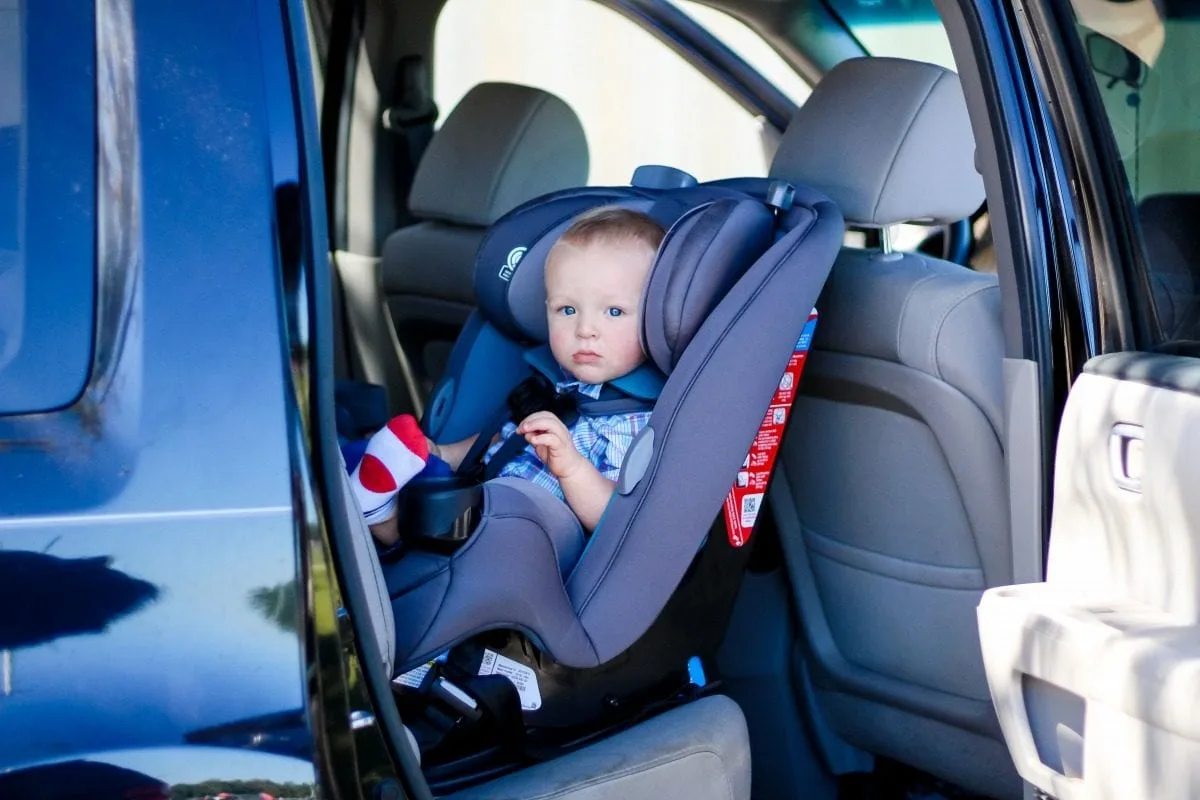
The answer to "when can my baby face forward in car seat" is later than most parents expect. It isn't tied to the first birthday, the old 20-pound rule, or what the playgroup swears by. It hinges on your child's measurements, your exact seat's limits, and your state's law.
The stakes back that patience. Children under 2 are roughly 75% less likely to be killed or seriously injured in a crash when riding rear-facing. That's the finding behind current American Academy of Pediatrics guidance.
Here's the short version first, then the physics, the law, and the exact switch steps.
when can my baby face forward in car seat
Your baby can face forward once they outgrow their car seat's rear-facing limits. Most convertible seats allow rear-facing up to 35 or 50 pounds. Most kids hit those limits between ages 3 and 5.
NHTSA guidance says to stay rear-facing as long as the seat allows. In several states, rear-facing until age 2 is law.
The Real Answer Isn't an Age: It's a Set of Conditions
Three things have to line up before you flip that seat around. Miss even one, and the switch waits.
First, your child has outgrown the rear -facing height and weight limits printed on the seat label and detailed in the manual.
Second, the seat itself is approved for forward-facing use. Infant-only carriers aren't. Convertibles and all-in-one seats are.
Third, your state's law permits it. Most states set a minimum age or weight, and a few now require rear-facing until age 2.
How to Read Your Seat's Limits Without Guessing
Car seat manuals use "or" and "and" very deliberately. A seat labeled "rear-facing 5 to 40 pounds and up to 40 inches" needs both limits met. Your child stays rear-facing until they hit either ceiling.
Weight limits get the headlines. Height usually ends extended rear-facing first.
A rear-facing seat is outgrown when your child's head sits less than 1 inch below the top of the shell. Once that gap closes, it's time to turn, no matter what the scale says. Rear-facing seats are also outgrown when your child exceeds the stated weight limit.
What the Law Says vs. What Safety Experts Recommend
These two don't always match. Legal minimums tend to trail best practice by years.
| Source | Rear-Facing Guidance | Flip Age |
|---|---|---|
| Most US state laws | Until age 1 or 2, weight-dependent | 1–2 years |
| AAP / NHTSA best practice | Until the seat's rear-facing limit | 2–4+ years |
| UK law (R129 / i-Size) | Until 15 months minimum | 15 months+ |
| Sweden / Norway norm | Until age 4–6 where seats allow | 4–6 years |
As of 2026, the gap between "legal" and "safest" remains wide. Meeting your state's minimum keeps you ticket-free. Meeting the seat's limit keeps your kid safest.
Why Rear-Facing Is Still the Safest Position (Even When It Gets Awkward)
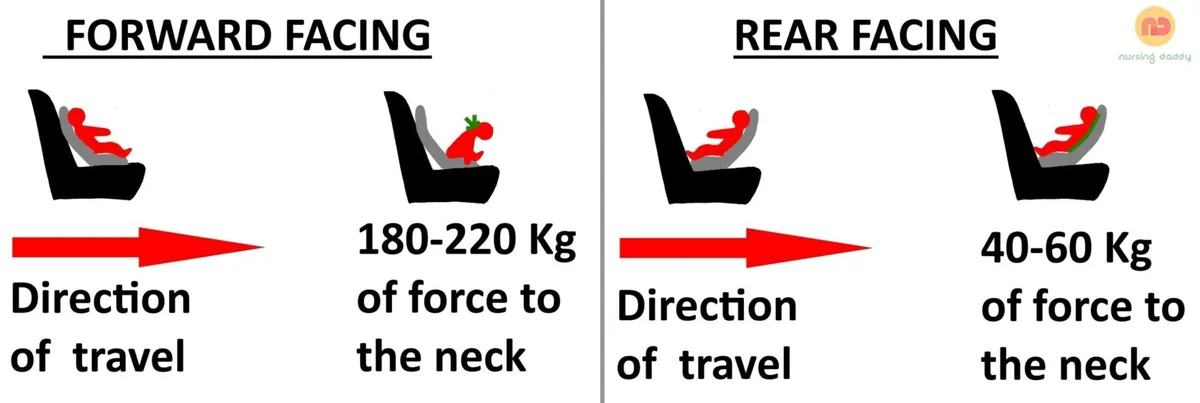
A toddler's head is disproportionately large and heavy. Their neck ligaments are still developing. In a frontal crash, a forward-facing child's head whips forward hard.
Rear-facing changes the physics entirely. The shell cradles the head, neck, and spine. Crash forces spread across the whole back instead of loading the neck.
That's why the mortality math is so lopsided. Peer-reviewed crash data shows rear-facing children under 2 have roughly 75% lower risk of serious injury or death than forward-facing peers. Not a small edge.
A massive one.
The awkward parts don't change the physics. Kids do complain about legs touching the seatback. Some get carsick.
Many parents feel pressure from grandparents or daycare to turn them.
None of that makes forward-facing safer. Bent legs are normal and comfortable for toddlers. Rear-facing is a temporary, low-consequence nuisance.
How to Know Your Child Is Actually Ready to Face Forward
Run through this checklist. Every box must be ticked before you turn the seat.
- Child exceeds the rear-facing weight limit OR
- Head is less than 1 inch below the top of the seat shell OR
- Child exceeds the rear-facing height limit
- Seat is a convertible, all-in-one, or combination model
- State law minimum age and weight are met
- Top tether anchor exists in your vehicle
- Seat has no recall, no crash history, and isn't expired
- Manual confirms forward-facing installation mode
Check the Seat, Not the Birthday
A 3-year-old who weighs 32 pounds and fits under the shell stays rear-facing. A 2-year-old who's 41 inches tall and has outgrown the shell flips. The seat decides, not the calendar.
What to Do If You're Not Sure
Get the install checked by a Child Passenger Safety Technician (CPST). Safe Kids coalitions run free inspection stations across the US. A CPST will confirm limits, recline angle, harness fit, and tether use in one visit.
Now let's cover the mistakes that quietly undo all of that.
The Mistakes That Turn a "Safe" Forward-Facing Switch Into a Risk
Most forward-facing failures aren't the seat's fault. They're installation and fit errors that happen in the first week.
Per NHTSA, roughly 46% of all car seats are installed incorrectly. Forward-facing seats are especially prone because they add a tether step most parents skip.
Skipping the Top Tether
The top tether strap is not optional when your vehicle has an anchor. It's required on virtually every forward-facing harness seat in the US.
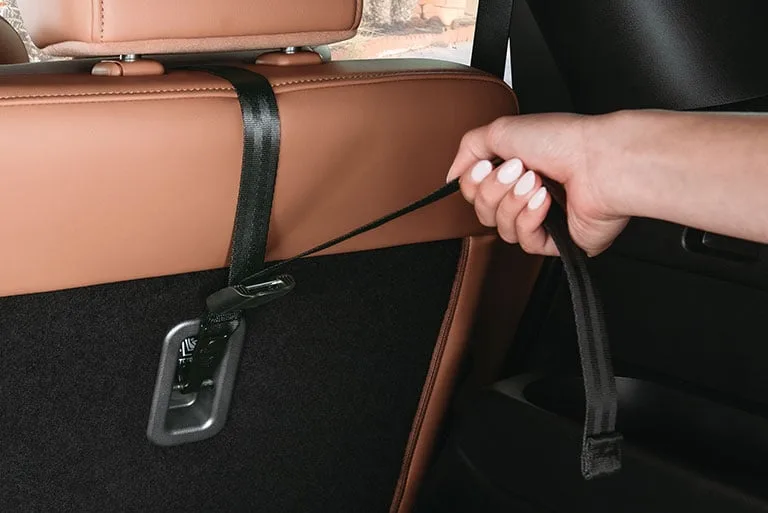
Without it, a child's head can move forward several extra inches in a crash. That's the difference between a close call and a spinal cord injury. The tether hooks to a designated anchor behind the seat, usually on the rear shelf or seatback.
Bundling Up Under the Harness
Puffy winter coats create a false sense of tightness. The harness feels snug over the fabric, but in a crash the padding compresses. Straps go slack.
The fix is simple. Buckle your child in a thin layer. Tuck a blanket over the harness after tightening, or have them wear the coat backward.
Using Aftermarket Inserts or Hand-Me-Down Seats
Anything not sold with the seat voids its certification. That includes head supports, strap covers, and bundle-me style bags under the harness.
Hand-me-down seats need extra scrutiny. Check for cracks, missing parts, expiration dates, and whether they've been in a moderate to severe crash. A seat involved in a bad crash gets replaced, even if it looks fine.
Installing in Front of an Active Airbag
Never place a rear-facing seat in front of an active airbag. The airbag deploys at over 100 mph and can kill a child. Forward-facing seats also belong in the rear row until your child is old enough to use the seat belt alone.
How to Make the Switch Correctly, Step by Step
Turning the seat is a twenty-minute job if you do it in the right order. Skip a step and you'll redo it.
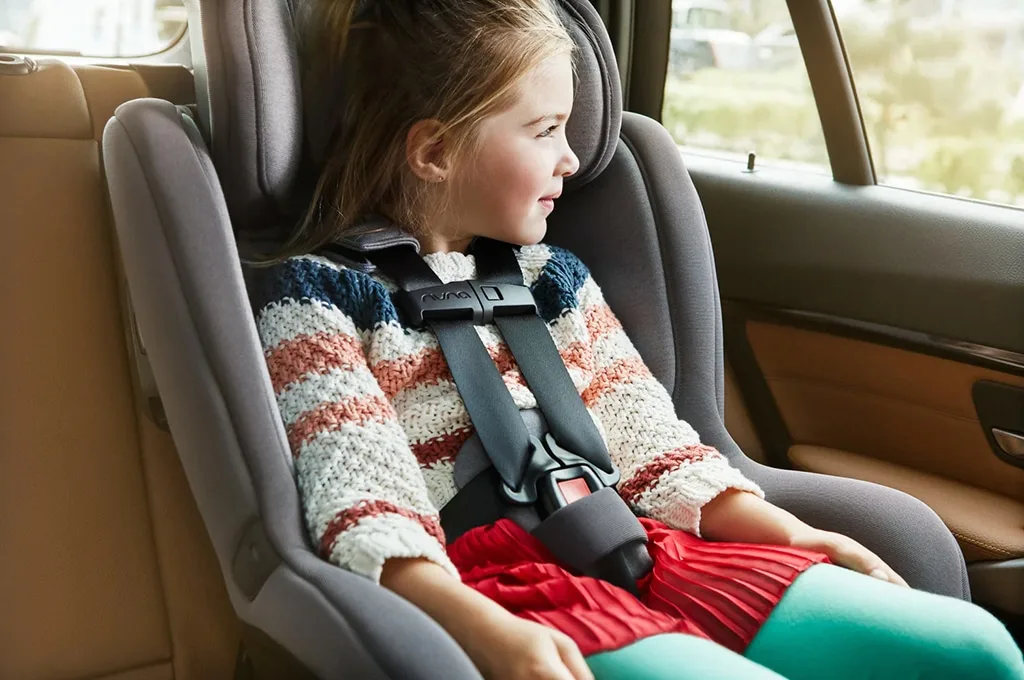
- Read the manual's forward-facing section. Recline the seat to the correct angle for forward-facing mode, which is different from rear-facing.
- Re-thread the harness. Strap slots move from at-or-below the shoulders to at-or-above. This is the step parents miss most.
- Install the seat using either the seat belt or LATCH. Check your vehicle manual for which is allowed in forward-facing mode. Some seats don't permit both.
- Attach the top tether to the designated anchor and pull it snug. Most vehicles have anchors on the rear shelf, seatback, or floor.
- Tighten the install. Test for less than 1 inch of movement at the belt path, front to back and side to side.
- Buckle your child in. Do the pinch test at the shoulder: if you can pinch slack fabric on the strap, it's too loose.
- Position the chest clip at armpit level and confirm the harness is flat, with no twists.
If any step feels wrong, stop and get a CPST inspection. It's free at most Safe Kids events.
When to Keep Them Rear-Facing Despite the Pressure to Turn
Keep them rear-facing whenever the seat still allows it, even if they seem bored or cramped. Every extra month rear-facing is real protection.
The most common pressure comes from well-meaning relatives. Grandparents grew up with the 1-year-and-20-pound rule. It's been outdated for over a decade.
Others turn early because of legroom. Kids fold their legs, prop them on the seatback, or sit cross-legged. Pediatric orthopedic research finds no link between this position and leg injuries in crashes.
Carsickness is trickier. If your toddler genuinely vomits on every rear-facing trip, a CPST or your pediatrician can help. In rare cases, forward-facing becomes the lesser risk.
Small vehicles force a real tradeoff. If you can't fit a rear-facing convertible behind the front seats, look at a slimmer model before you turn early. Brands like Clek, Nuna, and Diono make narrow options that fit tight back seats.
What Changes Once They're Forward-Facing (and What Doesn't)
Forward-facing isn't the finish line. It's a new set of rules.
What changes: the recline angle, the harness slot position, the tether requirement, and the shoulder belt path once they eventually move to a booster.
What doesn't change: harness snugness, chest clip position, the no-coats rule, and the ban on aftermarket add-ons. Forward-facing kids still need all of that.
Most forward-facing harness seats max out around 65 pounds. Once your child outgrows either the weight or height limit, they move to a belt-positioning booster. That's usually around age 5 to 7.
Kids stay in a booster until the seat belt fits without one. The benchmark is 4 foot 9 inches tall, typically between ages 8 and 12.
FAQs: Forward-Facing Car Seats, Answered Straight
Can my 1-year-old face forward?
No. One year is far too young for forward-facing under any modern guidance. The AAP and NHTSA both recommend keeping children rear-facing until they outgrow the seat's rear-facing limits.
That's usually age 2 at the absolute earliest, and often 3 or 4.
What if my child is big for their age?
Size alone doesn't qualify them. Check the seat's rear-facing height and weight limits first. If they've exceeded either, they're ready.
If not, keep them rear-facing until they do.
Does my state allow forward-facing at age 2?
Most US states set age 2 as the legal minimum for forward-facing. A handful still allow age 1. Check your specific state's car seat law.
Legal minimums and safety best practice are not the same thing.
Do I need the top tether for forward-facing?
Yes, when your vehicle has an anchor. Nearly every forward-facing harness seat requires the top tether. Skipping it increases head movement in a crash and can mean the seat doesn't meet its certification.
How do I know the seat is installed tightly enough?
Grab the seat at the belt path and tug. It should move less than 1 inch in any direction. Then do the pinch test on the harness at your child's shoulder.
If you can pinch slack, tighten the strap.
When does my child move to a booster seat?
When they've outgrown the forward-facing harness by weight or height. That's typically around 65 pounds or when the shoulders go above the top harness slot. Most kids are between 5 and 7 at that point.

Similar Posts