Can a Baby Wear a Coat in Car Seat? Safety Rules
Can a baby wear a coat in a car seat? The short answer is no, not a bulky one. A puffy winter coat compresses in a crash, leaving the harness loose when it matters most.
That single fact has changed how millions of parents buckle up their babies.
But the full answer has nuance. A thin fleece layer is a different story from a down-filled parka. So is a blanket draped over the buckled harness versus a coat worn under it.
In our research, follow-up studies on child restraint misuse consistently rank bulky clothing among the top preventable errors parents make.
Per FMVSS 213, the federal standard that governs child restraint systems in the US, car seats are tested with the harness directly against the child, not over outerwear. That gap between how seats are tested and how they're actually used is where the danger lives. Here's what the research, the manufacturers, and certified safety technicians actually say, and what you can do instead.
can a baby wear a coat in a car seat
No, not a bulky coat. A baby should not wear a puffy or bulky coat under the car seat harness. The coat compresses in a crash.
That creates dangerous slack in the straps. Dress your baby in thin layers instead. Buckle the harness snug, then add a blanket or coat on top.
Why a Puffy Coat Makes a Car Seat Unsafe
A puffy coat is basically a cushion of trapped air. It looks warm. It feels warm.
And under normal driving, it seems to hold the harness tight against your baby.
That's the illusion that gets parents into trouble.
What Actually Happens in a Crash
In a crash, the harness is supposed to hold the child's body against the seat shell immediately. The straps have to be tight before impact. If there's a coat between the straps and the baby, the coat compresses first.
Per NHTSA testing and crash physics, at 30 mph the body is thrown forward with a force equivalent to falling from a three-story building. The coat flattens. The baby moves several inches before the harness even engages any resistance.
That extra travel is exactly what the harness was designed to prevent.
The result can be the baby slipping out of the shoulders of the harness, or being ejected altogether.
The Pinch Test Every Parent Should Know
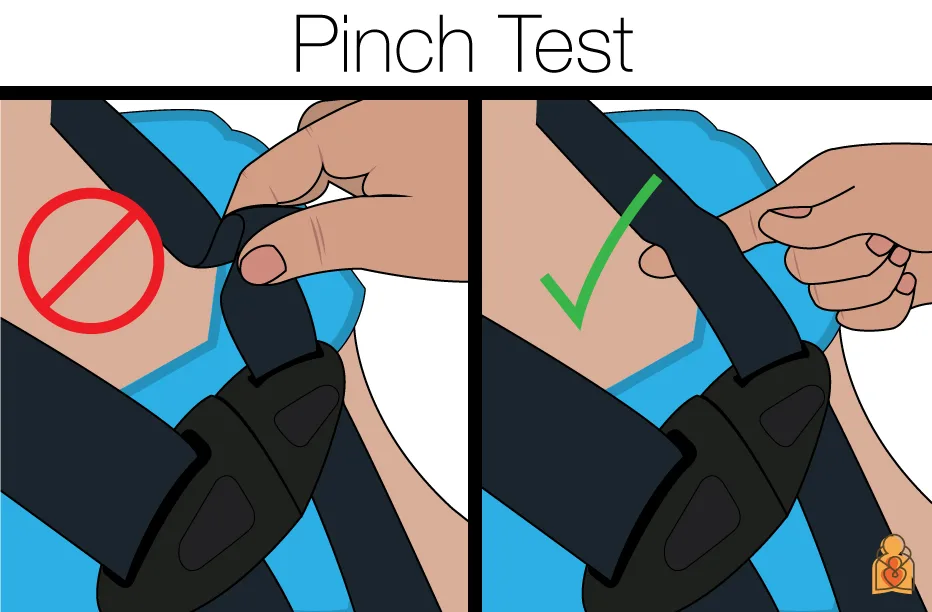
The pinch test is the simplest check you can do at every buckle-up. Here's how it works.
- Buckle and tighten the harness so it's snug against the child.
- Run your fingers along the strap webbing at the collarbone.
- Try to pinch a horizontal fold of the strap between your thumb and forefinger.
- If you can pinch any slack, it's too loose.
The same test applies whether the baby is wearing a coat or not. The point is that the harness must be tight against the body, not against the fabric. If you can pinch strap while the baby has a coat on, that slack gets worse, not better, once the coat compresses.
How Much Slack a Winter Coat Really Hides
The extra slack isn't small. Real-world measurements by child passenger safety technicians have found that a typical puffy toddler coat can hide between 1 and 4 inches of harness webbing. That's up to 10 centimeters of travel.
When a car seat is properly installed and the harness is snug without a coat, the child moves roughly an inch or less in a frontal crash. Add a bulky coat and that distance multiplies. The difference between 1 inch and 4 inches of movement is often the difference between walking away and a serious injury.
Image source: Bing (Web (fair-use with source credit))
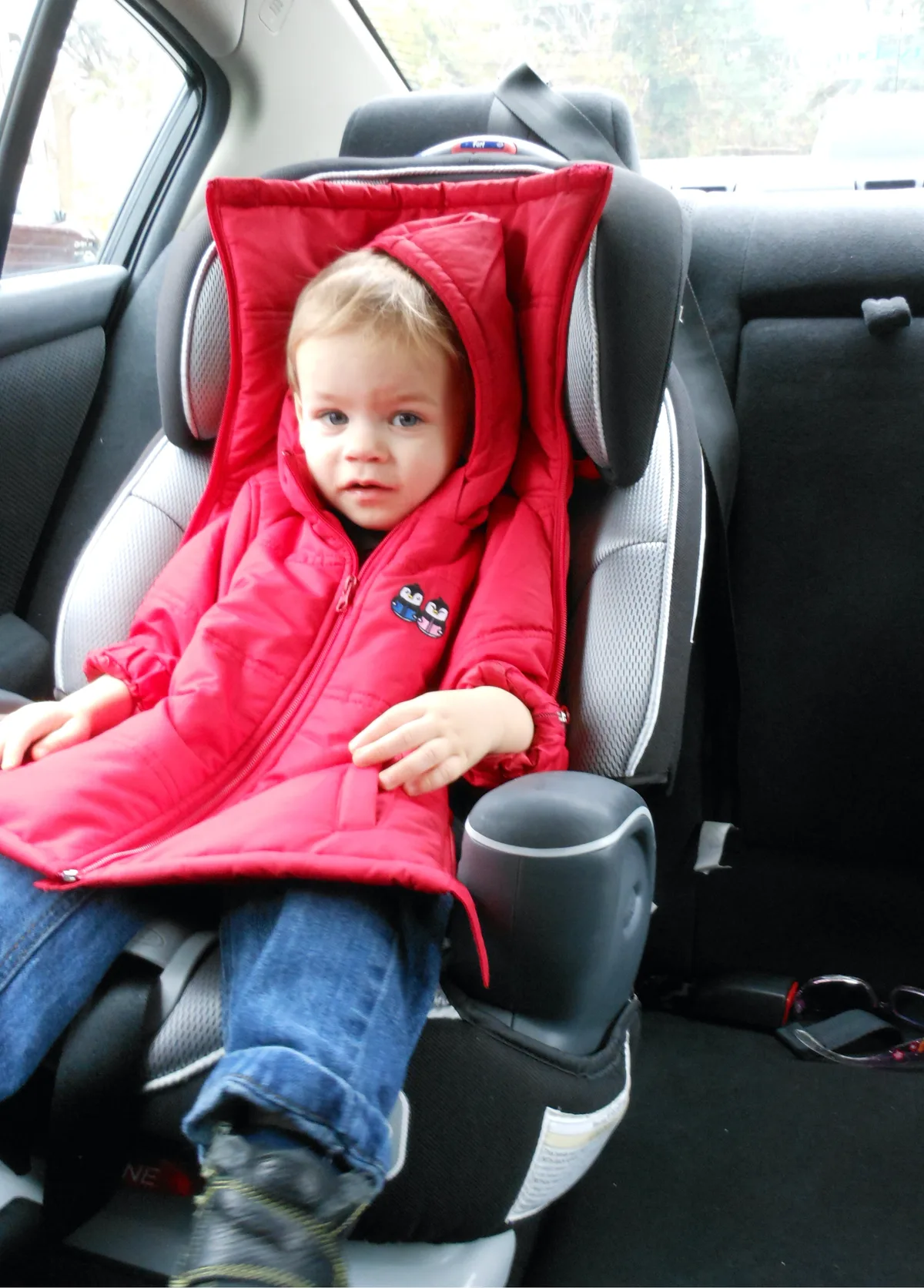
Image source: Web (Bing) / storage.googleapis.com (Web image (fair-use with source credit))
When a Coat Is Actually Fine — And When It Isn't
Blanket bans almost never work with real parents. So let's be specific about what's okay and what isn't.
Thin Fleece and Light Layers: Usually Okay
A thin fleece jacket, a light cardigan, or a cotton hoodie is generally fine under the harness. The key word is thin. If you can easily fold the fabric flat between your fingers, it's not adding meaningful slack.
Test it with the pinch test. Buckle the baby in the light layer, tighten the harness, and confirm you can't pinch webbing at the collarbone. If that passes, you're good.
Note that fleece is not the same as "fleece-lined puffer." Look at the actual thickness. A 100-weight fleece is fine. A 300-weight Sherpa fleece with a quilted lining is not.
Bulky Puffy Coats and Snowsuits: Never Under the Harness
Puffy coats, down jackets, snowsuits, bunting bags, and anything with loft are the ones to keep out from under the harness. That includes the ones marketed as "car seat friendly."
If a product uses the words "loft" or "fill power," treat it as too bulky. Same for any coat that visibly expands when you squeeze it.
Rigid snowsuits are actually the worst offenders. They don't just compress. They can push the chest clip out of position too.
A chest clip riding low on the belly is far less effective than one sitting at armpit level.
The "Coat Trick" Test That Tells You in 10 Seconds
If you want a definitive answer on any specific coat, use the coat trick test.
- Buckle the baby in with the coat on.
- Tighten the harness the way you normally would.
- Without loosening anything, unbuckle and take the baby out of the seat.
- Take the coat off the baby.
- Put the baby back in and rebuckle. Do not adjust the straps.
If the harness is now noticeably loose, the coat is too bulky. If it's still snug, the coat passes. That's it.
Ten seconds, no guesswork.
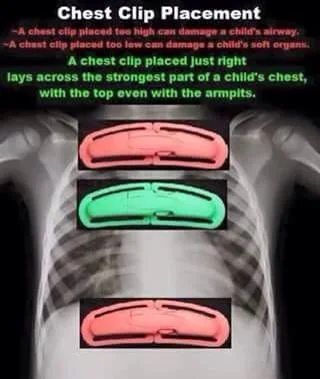
Image source: Web (Bing) / pinterest.com (Web image (fair-use with source credit))
Safe Ways to Keep Your Baby Warm in a Cold Car
The good news: your baby can absolutely stay warm and be safe in the car. It just means changing the order of operations.
Layering That Works With the Harness, Not Against It
Dress for the car in thin layers, not one big one. A cotton base layer, a light fleece mid-layer, and maybe a thin knit hat will do more than any single bulky coat.
Then do the outerlayering after the harness is snug. A blanket over the buckled baby is the simplest safe option. A poncho-style cover works too because it drapes over the seat and straps rather than sitting underneath.
Blankets, Ponchos, and Coats Worn Over the Buckled Harness
Wearing the coat backward, on top of the harness, is a popular trick. You buckle the baby in, then put the coat on with the front facing the seat back. The baby stays warm and the harness stays tight.
Just be careful with the coat's edges. You don't want to wedge fabric under the straps when you put it on. Coats worn backward need to sit fully outside the harness path.
The Car Seat Poncho and similar products are designed for exactly this. They use a hole for the head, drape over the seat, and never sit between the baby and the straps.
Car Seat Covers: Which Ones Are Safe, Which Ones Aren't
This is where a lot of well-meaning parents get tripped up.
- Safe: Shower-cap style covers that fit over the top of the infant carrier. They don't touch the baby's body and don't go under the harness. The Jolly Jumper-style covers are a common example.
- Safe: Covers that clip or snap onto the seat's canopy and cover the whole carrier from the outside.
- Not safe: Any cover that slots between the baby and the seat, lines the harness, or sits directly under the baby.
- Not safe: Any zippered "bunting" or "footmuff" that threads the harness through its own openings.
The rule: if it goes between the baby and the seat, or the straps go through it, walk away.
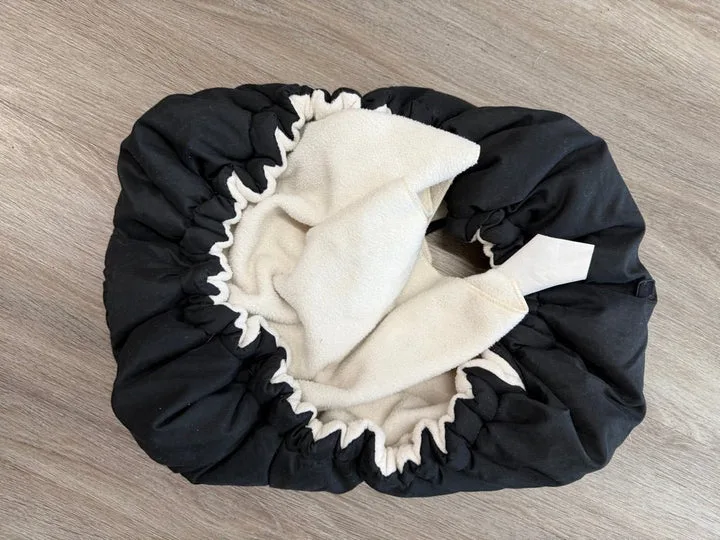
Image source: Bing (Web (fair-use with source credit))
Pre-Warming the Car Before You Buckle Up
Remote start and pre-heating go a long way. Even 3 to 5 minutes of running heat takes the chill off the fabric of the car seat, which is often the coldest surface your baby touches.
If you don't have remote start, start the car before you bring the baby out of the house. On very cold days, lay a warm blanket on the car seat for a minute, then remove it before buckling the baby in. Never leave the blanket in place under the straps.
Common Mistakes Parents Make (And How to Fix Them)
Parents don't usually ignore car seat rules on purpose. They miss small details that add up.
- Assuming a "car seat safe" coat label means it's tested under the harness. Very few products are actually crash-tested with a car seat. If the packaging shows a car seat, check whether the manufacturer tested it or just photographed it.
- Tightening the harness "a little extra" to compensate for a coat. Extra tightening doesn't fix the compression problem, it just squeezes the coat and leaves the baby uncomfortable.
- Leaving blankets bunched under the harness. Even a bunched-up receiving blanket is unsafe if it sits between the straps and the baby.
- Using one of those fluffy car seat liners that goes under the baby. Aftermarket inserts are rarely crash-tested and can void the seat warranty.
- Forgetting the chest clip. It should sit at armpit level, every time, no exceptions, regardless of what the baby is wearing.
- Skipping the pinch test on short trips. Crashes don't care that you were only going two blocks.
The fix for most of these is simple. Buckle first, without outerwear. Add warmth after.
Do the pinch test every time.
What Safety Experts and Car Seat Manufacturers Actually Say
Regulators and safety bodies are consistent on this. NHTSA's guidance on child passenger safety warns that bulky clothing can prevent the harness from being tight enough against a child's body. In our research, that single sentence underpins almost every official recommendation you'll see on the topic.
The American Academy of Pediatrics says the same thing in different words. Dress your baby in thin layers, buckle the harness snugly, then add blankets or a coat on top of the buckled harness. No exceptions for short trips, and no exceptions for a "really cold day."
NHTSA and AAP Guidance
Both agencies recommend the pinch test as the standard snugness check. If you can pinch webbing at the collarbone, the harness is too loose, period. This is a universal standard that applies whether your child is in an infant carrier, convertible seat, or all-in-one.
The AAP also recommends rear-facing until at least age 2, or until the child maxes out the seat's rear-facing height and weight limits. Rear-facing is a separate safety practice, but it interacts with the coat question. A rear-facing infant is more enclosed in the seat shell, which means a bulky coat is even harder to compress away from the straps.
Car Seat Manuals, Aftermarket Products, and Warranty Traps
Your specific car seat manual is the final word on what's allowed in your seat. Britax, Graco, Chicco, Nuna, Clek, Cybex, and Maxi-Cosi all include nearly identical warnings about bulky clothing and unapproved aftermarket products.
Aftermarket inserts, harness covers, fleece liners, and bunting bags almost never carry the manufacturer's approval. Using them can void your car seat warranty and, worse, invalidate the seat's FMVSS 213 certification. The seat was certified as tested.
Add something it wasn't tested with, and you've voided that guarantee.
If a product claims to be "car seat safe," check whether the maker actually crash-tested it. Most haven't. The label is marketing, not a certification.
FAQs: Coat, Car Seat, and Cold-Weather Questions Parents Ask
Can a baby wear a thin fleece jacket in a car seat?
Yes, usually. A thin fleece layer that compresses flat under a snug harness is generally fine. Do the pinch test to confirm no webbing slack.
If you can pinch strap at the collarbone, the layer is too bulky for that seat.
Is it safe to buckle the baby in with a coat and then take the coat off?
That's the coat trick test, not a safe way to travel. It tells you whether a specific coat is too bulky, but the baby still shouldn't ride with the coat under the straps. Buckle them in without the coat for actual trips.
What about a car seat cover with a zipper or bag shape?
Any cover that goes between the baby and the seat, or has the harness threaded through it, is unsafe. Shower-cap style covers that fit over the top of the infant carrier are fine. They never touch the harness path.
Can I put a blanket over the buckled baby?
Yes. A blanket draped over the buckled harness is one of the safest ways to keep a baby warm in a cold car. Just make sure it doesn't bunch up under the straps.
The harness stays against the baby's body, and the blanket sits on top.
Do car seat coats like the Road Coat or Buckle Me Baby Coat actually work?
Some do. These are specialty coats with a design that opens at the front so the harness can sit flat against the child's chest. Look for crash-tested claims from the manufacturer.
If a coat brand can't show test documentation, treat it like any other puffy jacket.
What should my baby wear in the car during winter?
A cotton base layer, a light fleece mid-layer, and a thin hat are the core setup. Add a blanket or poncho over the buckled harness. Skip bulky coats and snowsuits entirely for the car ride.
Final Word: The Rule That Keeps Your Baby Both Warm and Safe
The rule is simple, and it doesn't have to make winter harder. Buckle first, layer second. Harness snug against the body, warmth added on top.
That one change eliminates the single biggest winter car seat mistake parents make. It also keeps your baby comfortable and safe on every trip, whether you're driving two blocks or two hours.
Do the pinch test. Use the coat trick when you're unsure about a specific jacket. Check your car seat manual for what's approved.
And if you want a professional eye on your setup, a certified Child Passenger Safety Technician (CPST) can check your installation and harness fit for free at most fire stations and Safe Kids events.
Your baby stays warm. The harness stays tight. Everybody gets where they're going.
That's the whole answer in one line: coat on top, never under. Get the harness right first, then worry about the warmth.

Similar Posts