When Can Your Baby Face Forward in a Car Seat?
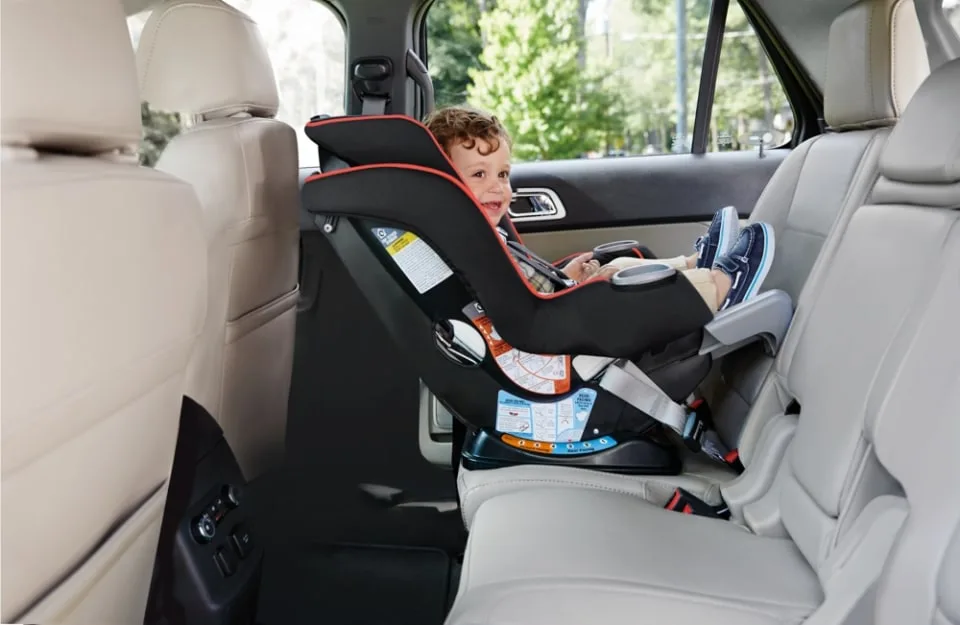
When can my baby face forward in a car seat? The honest answer isn't a birthday, and it's not a number you'll find stamped on the seat. It depends on your child's height, weight, and your specific car seat's limits, plus what your state requires.
Most kids aren't ready until somewhere between age 3 and age 5.
Here's the part that trips parents up: the old "age 1 and 20 pounds" rule is dead. The American Academy of Pediatrics (AAP) now says children should stay rear-facing until they outgrow the height or weight limit of their convertible seat, not when they hit a certain age. Federal Motor Vehicle Safety Standard 213 governs how these seats are tested.
Let's break down what that actually means for your toddler.
when can my baby face forward in a car seat
Most children can face forward once they've hit their car seat's maximum rear-facing height or weight limit. For many convertible seats, that's usually between 40 and 50 pounds, or around 40 to 49 inches tall. Practically, that lands most kids somewhere between age 3 and age 5.
The Real Reason Rear-Facing Matters So Much
Rear-facing isn't about comfort or convenience. It's about physics, and it's about how a toddler's body is built. A young child's head is huge relative to their body, and their neck bones haven't fully hardened yet.
Those two facts make front-facing crashes dangerous in a way that's easy to underestimate.
In a frontal crash, the car stops instantly. Your child's body doesn't. Rear-facing, the shell of the seat cradles the back and spreads the force across the whole spine, head, and neck.
Forward-facing, the harness holds the torso while the head whips forward. That forward motion is what causes the spinal cord injuries car seat engineers work so hard to prevent.
Image source: Bing (Web (fair-use with source credit))
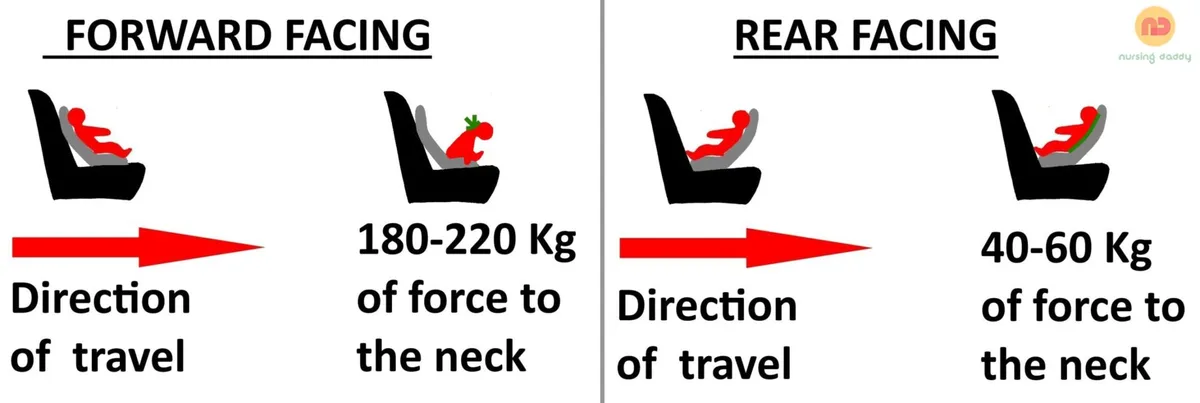
Image source: Web (Bing) / rivieradeifiori.org (Web image (fair-use with source credit))
The spine development angle matters more than most parents realize. Pediatric researchers describe the cervical vertebrae as still fusing through early childhood, which is why the AAP pushes extended rear-facing past the toddler years. In Sweden, kids routinely stay rear-facing until age 4 or 5, and their injury data reflects it.
Longer rear-facing isn't extreme. It's standard practice in countries with strong child passenger safety cultures.
Your Child's Actual Turning Point: Age, Height, and Weight
Your turning point is a single number: whichever rear-facing limit your seat hits first, height or weight. That's when you flip the seat. Not the calendar, not your neighbor's opinion, not the fact that your toddler's knees are touching the seatback.
What the AAP and NHTSA Actually Say
The AAP recommends keeping children rear-facing until they reach the highest weight or height allowed by their seat's manufacturer. NHTSA's guidance matches this. Neither organization endorses a specific age cut-off, because age alone tells you nothing about whether a child's body is ready for the forward-facing crash forces.
Why "Age 2" Isn't the Finish Line
Age 2 is a floor, not a ceiling. Many states set age 2 as the legal minimum for rear-facing, but that's a baseline for compliance, not a recommendation for what's safest. If your child still fits rear-facing at age 4, they should stay rear-facing at age 4.
Turning them early because "they're 2 now" throws away the single biggest safety advantage your seat offers.
Reading Your Seat's Height and Weight Limits
Every car seat has a label or a manual page listing its rear-facing minimums and maximums. Convertible seats typically top out rear-facing between 40 and 50 pounds. Height limits usually sit near 40 to 49 inches, though they vary by brand.
Flip the seat to forward-facing the moment your child crosses either line, and not a day sooner.
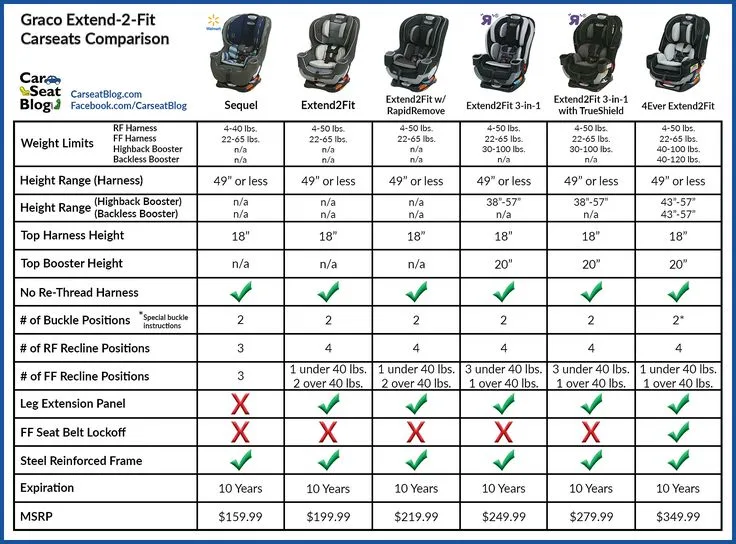
Image source: Bing (Web (fair-use with source credit))
One catch: height limits measure standing height, not seated height, on most seats. Measure your child against a wall with shoes off to get an accurate number. Guessing from memory is how parents accidentally leave a kid rear-facing too long or flip too early.
The State Law vs. Best Practice Gap
State law and best practice aren't the same thing, and confusing them is one of the most common parent mistakes. Laws set a minimum you must hit. Safety guidance sets a target you should aim for.
When the two split, follow the safer one.
| Region | Legal Minimum for Rear-Facing | Best Practice (AAP/Manufacturer) |
|---|---|---|
| Most US states | Age 2 (varies) | Outgrow seat's rear-facing limit |
| UK (R129/i-Size) | 15 months | Often 4+ years |
| Sweden | No strict age cut | 4 to 5 years typical |
| Canada | Varies by province | Outgrow seat limit |
As of 2026, several US states have updated their statutes to push the rear-facing requirement past age 2. Check your own state's current law through your DMV or highway safety office before you assume. Crossing into a neighboring state with different rules during a road trip doesn't exempt you.
You follow the law of the road you're on.
The legal floor exists because lawmakers know some parents won't do more than the minimum. That doesn't make the minimum the right target for your kid. It's a backstop, not a finish line.
How to Make the Switch Safely, Step by Step
Once your child has genuinely outgrown the rear-facing limits, here's the sequence. Don't skip steps, and don't rush it. A mis-installed forward-facing seat is actually less safe than a properly installed rear-facing one.
- Confirm the trigger: check the label or manual. Height or weight, whichever came first.
- Read both manuals. Your car seat manual and your vehicle owner's manual both matter here.
- Recline the seat. Forward-facing uses a different recline angle than rear-facing. Set it per the manual.
- Reroute the belt or LATCH strap. The routing changes for forward-facing mode.
- Attach the top tether. This is non-negotiable for forward-facing installs.
- Tighten the install. Test for less than one inch of movement at the belt path.
- Adjust the harness. Move the straps to the correct slot height, at or just above the shoulders.
- Check the chest clip. It should sit at armpit level, every single time.
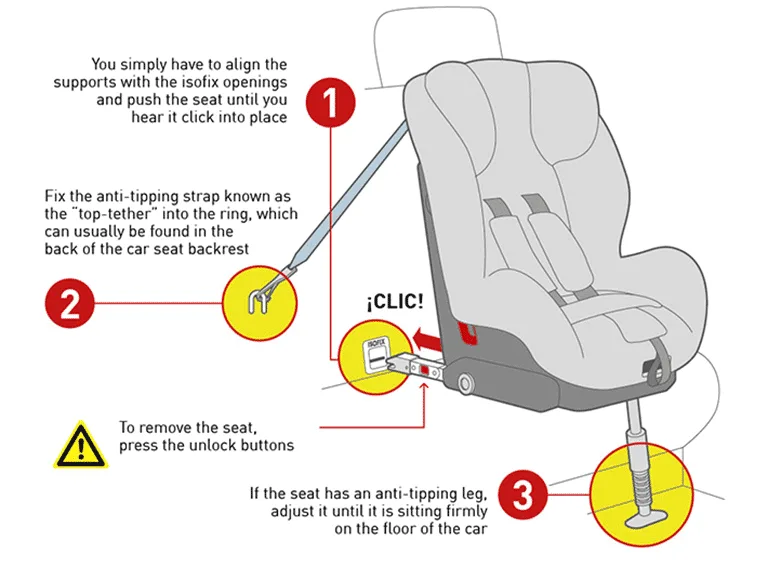
Image source: Bing (Web (fair-use with source credit))
The top tether is the step parents skip most. It anchors the top of the car seat to a designated point in your vehicle and cuts forward head movement dramatically in a crash. Your vehicle owner's manual lists where the tether anchors are.
If you can't find them, that's exactly when to book a free inspection.
A certified Child Passenger Safety Technician (CPST) will check your install in about 20 minutes, free at most fire stations and checkup events. Get the NHTSA car seat inspection guidance if you want to find a location near you. It's the single best hour you'll spend on car seat safety, and it's free.
Common Mistakes That Put Your Toddler at Risk
The most dangerous mistake is flipping the seat early because your toddler "wants to see out." Their preference doesn't change the crash physics. A forward-facing child under 4 faces a significantly higher risk of head and spine injury than a rear-facing one.
Here are the mistakes we see most often:
- Installing forward-facing without attaching the top tether
- Leaving the harness straps in the rear-facing slot position
- Using a seat belt and LATCH at the same time when the manual forbids it
- Adding aftermarket head supports, strap covers, or seat protectors that void the seat's tested configuration
- Relying on a hand-me-down seat with unknown crash history or an expired shell
- Routing the shoulder belt through the wrong path on a combination seat
The aftermarket product issue deserves a callout. Anything that sits between your child and the harness, or between the seat and the vehicle seat, can alter how the seat performs in testing. Manufacturer specs confirm these seats are certified as-is.
Add-ons mean you're driving an untested setup.
Expiration dates catch people off guard too. Car seats typically expire six to ten years from the manufacture date, because plastic degrades and standards change. The date is stamped on the shell or the label.
Check it before you trust any secondhand seat.
One more: the loose harness. A harness with slack lets your child move forward before the seat catches them. Run the pinch test at the shoulder every time.
If you can pinch the strap, it's too loose.
When to Get a Professional Car Seat Check
Get a professional check any time you change your seat's orientation, move it to a new vehicle, or aren't sure the install is right. There's no penalty for asking. Certified Child Passenger Safety Technicians (CPSTs) do this for free at thousands of locations.
You'll find technicians at many fire stations, police departments, and hospitals. NHTSA's site lets you search by ZIP code and filter by inspection type. Some areas also run seasonal checkup events where multiple technicians work through a parking lot of cars in a few hours.
A typical inspection runs about 20 to 30 minutes. The technician will check your install, verify the harness fit, confirm the recline angle, and show you what to adjust. They'll also walk you through your vehicle's tether anchor locations if you haven't found them.
If you've installed the seat yourself with the manual open and the tether attached, you're likely fine. Still, an inspection is the cheapest insurance you'll ever buy for your kid's safety. Book one before your first forward-facing drive.
Red flags that mean stop driving and get checked:
- You can't find the top tether anchor in your vehicle
- The seat moves more than an inch at the belt path
- The harness won't tighten fully
- You're mixing LATCH and seat belt without clear manual guidance
- The seat doesn't feel secure on the vehicle seat cushion
FAQs About Forward-Facing Car Seats
Can my child face forward at age 2?
No, not safely. Age 2 is only a legal minimum in many states, and the AAP recommends rear-facing well past that. Wait until your child outgrows the seat's rear-facing height or weight limit, usually around age 3 to 5.
What's the minimum weight for forward-facing?
It depends on your seat. Most forward-facing harness minimums start at 20 to 22 pounds, but that's the absolute floor for the seat to function. It's not a recommendation to switch.
Follow the rear-facing maximum instead.
How do I know my child has outgrown the rear-facing seat?
Check two numbers: standing height and weight. When your child hits either the seat's rear-facing height or weight limit, whichever comes first, they've outgrown it. The limit is printed on the seat label and in the manual.
Is forward-facing with a top tether required?
For forward-facing harness seats in the US, yes, in most cases. FMVSS 225 requires tether anchors in vehicles, and the seat's manual tells you to use them. Skipping the tether raises the risk of forward head movement in a crash.
Can I turn my child forward-facing for a long road trip?
Don't do it for convenience. The seat orientation doesn't change based on trip length, and flipping back and forth between orientations means rechecking the install each time. Keep them rear-facing until they outgrow the seat.
Does a forward-facing seat need a different recline angle?
Yes. Forward-facing seats use a more upright recline than rear-facing. Your seat manual shows the correct angle for each mode, and getting it wrong can affect how the harness and tether perform in a crash.
Your Decision Guide: Rear-Facing vs. Forward-Facing at a Glance
Here's the short version. Keep your child rear-facing until they outgrow the seat's rear-facing limit, which for most convertible seats means 40 to 50 pounds or roughly 40 to 49 inches tall. That usually lands between age 3 and age 5.
Then switch, attach the top tether, and book a free inspection.
| Situation | What to Do |
|---|---|
| Child still under rear-facing limit | Keep rear-facing, no exceptions |
| Child has hit height or weight limit | Switch to forward-facing with top tether |
| Unsure if child has outgrown the seat | Measure standing height and weight, check label |
| State law says age 2, seat limit says age 4 | Follow the seat limit, it's safer |
| Installing forward-facing for the first time | Get a CPST inspection before the first drive |
If your child is on the smaller side, they'll likely stay rear-facing longer. If they're tall or heavy for their age, they'll hit the limit sooner. Either way, the seat's numbers decide, not the calendar.
The push to turn kids around early usually comes from comfort complaints. A toddler's legs touching the seatback looks uncomfortable to us, but it isn't unsafe. Kids fold their legs, prop them up, or sit cross-legged without issue.
Rear-facing leg contact isn't a safety concern, and it's never a reason to flip the seat.
Once you do make the switch, treat it as a permanent change for that seat and that child. Recheck the install, recheck the harness fit, and confirm the tether. Then drive with confidence, because you've done the part that matters most.

Similar Posts































